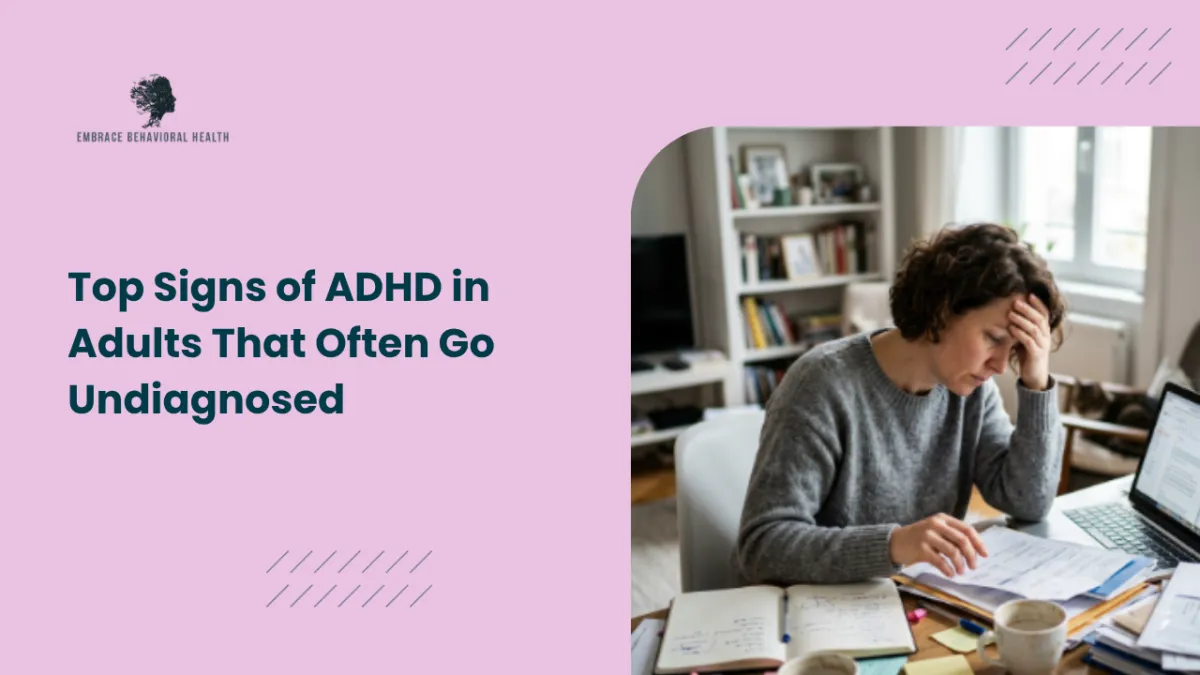
Top Signs of ADHD in Adults That Often Go Undiagnosed | Embrace Behavioral Health
Have you ever sat down to start something important and found yourself, thirty minutes later, watching a video about how pencils are made? Or arrived somewhere and had absolutely no memory of driving there? Maybe you’ve been told your whole life that you’re smart but scattered, full of potential but impossible to pin down.
If any of that sounds familiar, you’re not alone, and you’re not broken. For millions of adults, these moments aren’t personality quirks or personal failures. They could be signs of ADHD that were never caught.
Attention-Deficit/Hyperactivity Disorder is still widely thought of as a childhood condition. But the truth is that ADHD follows most people straight into adulthood, often wearing a different costume that even trained professionals can miss. Many adults spend decades managing symptoms they don’t have a name for, building workarounds, burning out, and quietly wondering why things that seem effortless for everyone else feel like climbing a mountain for them.
If you’ve ever wondered whether ADHD could explain a lifetime of “almost,” this guide was written for you.
Ready to stop guessing and start understanding how your brain actually works? Schedule a comprehensive ADHD evaluation at Embrace Behavioral Health and get the clarity you’ve been searching for.
Schedule Your ADHD Evaluation Today
Why So Many Adults With ADHD Never Get Diagnosed
The reason so many adults slip through the cracks isn’t a failure of intelligence or awareness. It’s a failure of the old diagnostic playbook.
For a long time, ADHD was primarily associated with hyperactive young boys bouncing off classroom walls. If you didn’t fit that picture, if you were a quiet girl who daydreamed, a high-achieving student who somehow always turned things in on time (even if it nearly killed you), or someone who seemed “fine” from the outside, the diagnosis simply wasn’t on anyone’s radar.
Coping mechanisms are another big piece of the puzzle. Highly intelligent people with ADHD are remarkably good at building elaborate internal systems to compensate for their symptoms. They make more lists, set more alarms, and expend far more energy than their peers just to reach the same finish line. It works, until it doesn’t. A major life transition, a new job, a baby, a loss, can be enough to overwhelm those systems, and suddenly the symptoms that were always there become impossible to ignore.
And then there’s the overlap. ADHD shares significant symptom territory with anxiety, depression, and trauma. Someone who’s been anxious and exhausted for years may have been treated for those conditions without anyone ever connecting the dots back to ADHD underneath it all.
At Embrace Behavioral Health, we’ve seen this pattern more times than we can count. Our team is here precisely because you deserve more than a rushed appointment and a one-size-fits-all answer.
The Most Common Signs of Undiagnosed ADHD in Adults
Adult ADHD rarely looks the way people expect. Here are the signs that most commonly go unrecognized, and how they tend to show up in real daily life.
1. You Lose Time Without Noticing
Not just occasionally running late, chronically misjudging how long everything takes, in every direction. You sit down to send one email and emerge two hours later having done seventeen things that weren’t on your list. Or you’re convinced a task will take a week and finish it in a single obsessive evening. Time feels elastic in ways that genuinely confuse you, and schedules feel like suggestions written in a language you’re still learning.
2. Starting Feels Easy. Finishing Feels Impossible.
The ideas come fast and bright. You launch projects with real enthusiasm and genuine intention. But somewhere in the middle, when the novelty wears off and it becomes routine work, your brain simply loses the signal. Half-finished projects pile up, in your home, on your hard drive, in the back of your mind where they quietly drain your energy and self-esteem.
3. Your Attention Is Selective, and Completely Out of Your Control
This one surprises people. ADHD isn’t about a short attention span. It’s about an inconsistent one. Adults with ADHD often experience hyperfocus, the ability to lock onto something genuinely interesting with laser-like intensity for hours. But that same person can’t make themselves pay attention to something important and tedious no matter how hard they try. The frustrating part is that it doesn’t feel like a choice. It genuinely isn’t.
4. Emotional Reactions Feel Larger Than the Situation Warrants
Minor criticism lands like a punch. A small disappointment spirals into an hours-long mood. Traffic makes you irrationally furious. This emotional intensity, sometimes called rejection sensitive dysphoria, is one of the most overlooked features of adult ADHD. People may have spent years being told they’re “too sensitive” or “dramatic” when what’s actually happening is a neurological difference in emotional regulation, not a character flaw.
5. You’re Always in Your Own Head
While your face is in a meeting, your brain is having three other conversations. Racing thoughts, constant internal chatter, and a mind that simply refuses to quiet down, especially when you actually need to rest, are hallmarks of adult ADHD. The hyperactivity that looked like bouncing off walls in childhood often becomes internal restlessness in adulthood. It’s exhausting in a way that’s hard to explain.
6. Forgetfulness Goes Beyond Misplacing Keys
Everyone forgets where they put their phone. But forgetting entire conversations you had this morning? Blanking on commitments you made sincerely and genuinely intended to keep? Missing appointments that mattered to you? This is a different animal. ADHD-related forgetfulness isn’t carelessness, it’s a consistent pattern that disrupts relationships, careers, and self-confidence over time.
7. Organization Feels Like a Language You Never Learned
Other people seem to have an internal filing system that just works. Yours seems to have been delivered without instructions. Keeping a clean workspace, maintaining systems, following multi-step processes, and prioritizing competing tasks all require executive function skills that ADHD directly impacts. It’s not that you don’t care about order. It’s that your brain genuinely processes organization differently.
8. You Interrupt Without Meaning To
You’re not trying to be rude. The thought appears, fully formed and urgent, and if you don’t say it now, it’s gone. Impulsivity in adults often shows up in conversations, decisions made without thinking through consequences, and a general difficulty with the pause that others seem to have built in between thought and action. It can damage relationships and professional opportunities in ways that feel deeply unfair.
9. You Struggle to Read, Listen, or Sit Through Things
Reading the same paragraph four times and still not being able to say what it said. Zoning out of a presentation despite genuinely trying to pay attention. Being physically restless during meetings or movies. These experiences point to a brain that isn’t malfunctioning, it’s differently wired, and it needs support that matches how it actually works.
10. You’ve Built Your Whole Life Around Avoiding the Hard Parts
This is the subtlest sign of all. Many high-functioning adults with ADHD have unconsciously shaped their careers, relationships, and routines to minimize exposure to their weakest areas. The result is a life that looks fine from the outside but feels like an elaborate performance, one that requires exhausting levels of energy just to maintain.
Not sure if what you’re experiencing is ADHD?
Explore our ADHD evaluation and treatment services at embracebehavioral.com and take the first step toward finally understanding your brain.
ADHD Looks Different Depending on Who You Are

It’s worth saying plainly: ADHD presents differently across genders, ages, and life circumstances, and those differences are part of why it goes undetected so often.
Women and girls with ADHD are significantly more likely to present with inattentive symptoms, daydreaming, disorganization, emotional sensitivity, rather than the hyperactive, disruptive behavior that still dominates the public image of the condition. They’re more likely to internalize their struggles, compensate quietly, and receive diagnoses of anxiety or depression instead.
Older adults may have developed such sophisticated coping strategies over decades that their symptoms are nearly invisible until circumstances shift, retirement, illness, or loss of structure can strip away the scaffolding they’ve been relying on.
And for people in high-achieving environments, ADHD can coexist with real success and still cause real suffering. Reaching a certain level of accomplishment doesn’t mean the symptoms have gone away. It often just means the person has been working twice as hard as everyone else to get there.
ADHD Rarely Travels Alone
One of the most important things to understand about adult ADHD is that it almost never shows up by itself. Research consistently shows that ADHD frequently co-occurs with anxiety disorders, depression, sleep disorders, PTSD, and in some cases, substance use disorders, often as a form of self-medication that developed long before anyone had a name for what was being treated.
This overlap is precisely why proper evaluation matters so much. Treating anxiety without recognizing the ADHD beneath it, or managing depression without addressing the executive function challenges driving it, can only go so far. A thorough evaluation that looks at the whole picture, not just the loudest symptom, is what leads to treatment that actually works.
At Embrace Behavioral Health, our comprehensive screening covers more than 80 mental health conditions in a single evaluation. We also use QbCheck, an FDA-recognized objective assessment tool that measures attention, impulsivity, and activity levels with clinical precision, going well beyond self-report alone.
What an ADHD Evaluation at Embrace Behavioral Health Looks Like
If you’ve been putting off getting evaluated because you’re not sure what to expect, here’s a straightforward look at the process.
It begins with a genuine conversation. Your provider will ask about your current symptoms, how long they’ve been present, your mental health history, and how they’re affecting your daily life at work, at home, and in your relationships. This is the foundation, and it’s a judgment-free zone. There are no wrong answers.
From there, clinical assessment tools help build a clearer, more objective picture of what’s going on. The QbCheck assessment measures symptoms in a standardized, data-driven way that supplements what you’re able to describe in words.
Part of the evaluation also involves ruling out, or identifying, co-occurring conditions, because treating ADHD in isolation when anxiety or depression are also present will only get you so far.
Once everything is reviewed, your provider walks you through the findings in detail. If ADHD is confirmed, you leave with a real diagnosis, a clear explanation of how it’s been shaping your experience, and a personalized treatment plan built around your specific symptoms and goals.
Treatment may include medication, behavioral strategies, lifestyle modifications, or some combination of all three. Stimulant medications are highly effective for many people; non-stimulant options are also available for those with co-occurring anxiety or other considerations. And our approach doesn’t stop at medication, we integrate nutritional guidance, mindfulness practices, and educational resources because we know that long-term wellbeing requires more than a prescription.
Telehealth ADHD Evaluation: Get Answers From Home
Finding time for mental health care when you’re also managing work, family, and the general chaos of adult life is its own challenge. That’s why Embrace Behavioral Health offers secure telehealth services that let you complete your evaluation and follow-up care from wherever you are.
Whether you’re in Vernon Hills, Libertyville, Mundelein, or anywhere across Lake County, IL, our team is accessible, flexible, and ready to meet you where you are, no commute required.
Prefer care from home? Book a secure telehealth ADHD evaluation with our experienced providers and get the answers you need, without leaving the house.
Book Your Telehealth Evaluation Now
You Don’t Have to Keep Wondering
There’s something quietly exhausting about not knowing. About spending years suspecting that something is different about the way your brain works, but never having a name for it, never having a path forward.
Getting evaluated isn’t about receiving a label. It’s about getting information, real, clinical, individualized information about how your brain is wired, so that you can finally stop working against yourself and start working with yourself. So that the strategies you try actually match the problem you have. So that you can stop carrying the weight of thinking this is simply who you are, unfixable, when the truth is so much more hopeful than that.
At Embrace Behavioral Health, our team of highly credentialed psychiatric nurse practitioners brings over 19 years of healthcare experience and a genuine commitment to seeing every patient as a whole person. We treat adults 18 and up, and we believe that accurate diagnosis and personalized, compassionate care can change lives.
Because they can. And yours is worth it.
Why Choose Embrace Behavioral Health?
Compassionate, patient-centered evaluations with no rush and no judgment
FDA-recognized objective testing with QbCheck for precise, data-driven insights
Comprehensive screening for 80+ mental health conditions in one evaluation
Personalized treatment plans tailored to your life, symptoms, and goals
Integrative psychiatry options that go well beyond medication alone
Convenient in-person and telehealth appointments across Lake County, IL
Expert medication management with careful, ongoing follow-up care
Frequently Asked Questions
Can I really be diagnosed with ADHD as an adult if I was never diagnosed as a child?
Absolutely. Many adults receive their first ADHD diagnosis in their thirties, forties, or even later. In some cases, symptoms were always present but never recognized. In others, increased demands, a new job, parenthood, or loss of structure, make symptoms more visible. It is never too late to seek an evaluation.
What if I’ve already been diagnosed with anxiety or depression? Could I still have ADHD?
Yes, and it’s actually quite common. ADHD frequently co-occurs with anxiety and depression, and the symptoms overlap significantly. A comprehensive evaluation at Embrace Behavioral Health is designed to look at the full picture and ensure that all underlying conditions are identified and addressed together.
Will I automatically be put on medication if I’m diagnosed with ADHD?
Not necessarily. Medication is one effective option, but every treatment plan at Embrace Behavioral Health is personalized. Some patients do best with a combination of medication and behavioral strategies. Others start with non-medication approaches. The goal is to find what genuinely works for you.
How long does the evaluation take?
The timeline can vary depending on the depth and complexity of your evaluation. Initial consultations at Embrace Behavioral Health are thorough and cover your full history, current symptoms, and goals, so you leave with real answers, not just surface-level impressions.
Do I need a referral to schedule an ADHD evaluation?
In most cases, no referral is needed. You can contact Embrace Behavioral Health directly to schedule your evaluation, including via secure telehealth if that works better for your schedule and location.
Does Embrace Behavioral Health offer telehealth appointments?
Yes. Embrace Behavioral Health provides secure, confidential telehealth services for both initial evaluations and follow-up care. Whether you’re in Vernon Hills, Mundelein, Libertyville, or elsewhere in Lake County, IL, you can receive the same quality of care from the comfort of your own home.